
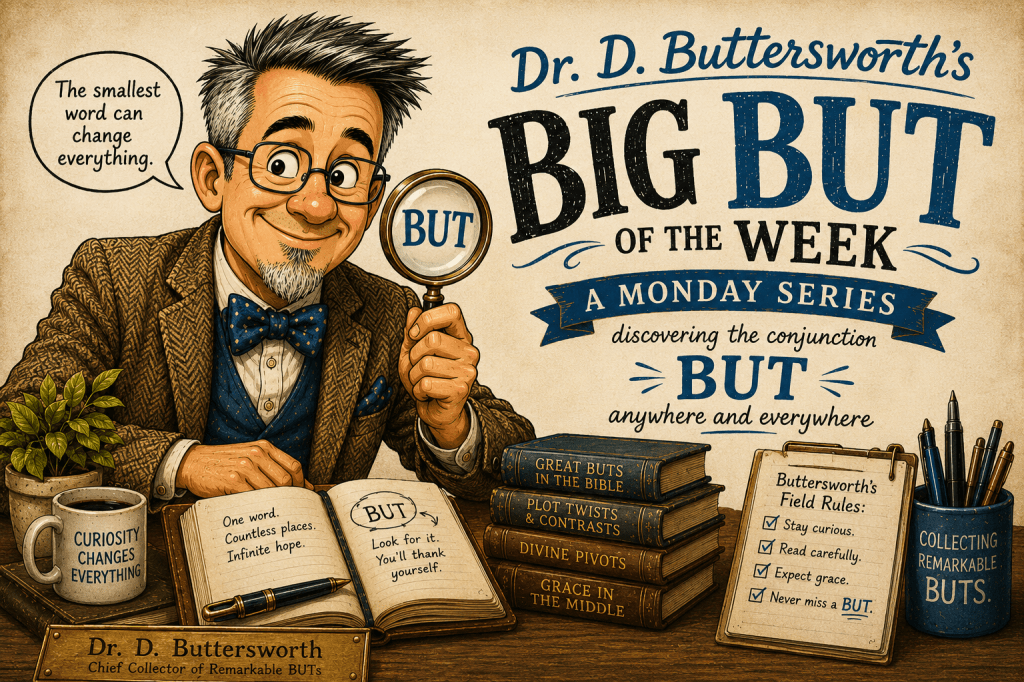
There was a time when your good doctor knew Greek.
Not “I recognize a few Greek letters from fraternity houses” Greek. Actual Greek. Koine Greek. New Testament Greek. There was a time, many years and several million dead brain cells ago, when I could open a Greek New Testament and read the thing with reasonable fluency.
There was Hebrew, too. We needn’t discuss Hebrew.
Suffice it to say, I endured Biblical language studies, after which I entered pastoral ministry and discovered that almost nobody experiencing an actual crisis cared whether I could parse a Greek participle. Nobody ever called me at two in the morning and said, “Pastor, my marriage is falling apart. Before we talk, could you tell me whether this verb is an aorist active indicative?”
So the languages went largely unused. And unused languages, I have recently discovered, apparently crawl into some dark corner of the brain, cover themselves in cobwebs, and die.
Which brings us, naturally, to but.
Conjunction Junction
Those of us of a certain age learned everything we needed to know about conjunctions on Saturday mornings.
Conjunction Junction, what’s your function?
Schoolhouse Rock taught us that conjunctions are little words that connect things. And. Or. But. Grammar instruction cleverly disguised as a cartoon.
As longtime readers of this scholarly journal know, your Dr. Buttersworth has devoted considerable intellectual energy to that particular three-letter word. Mostly because somebody named an entire website after it.
So I decided to investigate. How complicated could but possibly be?
My head hurts.
Before There Was But
Our little word but has been around a very long time. Its Old English ancestors carried ideas such as outside, without, or except. Think “all but one.” Everybody except one.
Over centuries, the word developed the adversative job we know today. Something is true. But something else is also true. Something is headed one direction. But something changes it.
Which makes but a fascinating little word. It warns us not to stop reading. Everything you’ve heard so far may be completely true.
But there is more to the story.
Now that sounded familiar.
So naturally I opened the Greek. This was my first mistake.
Apparently, “But” Does Not Mean “But”
I vaguely remembered there being more than one Greek word that could become but in an English Bible.
Vaguely, it turns out, was doing considerable work in that sentence.
One is ἀλλά—alla.
Some of you are impressed that I can still type that.
So am I.
‘Aλλά can provide a fairly strong contrast: but, rather, on the contrary, nevertheless.
Not this. But that.
Consider Jesus praying in Gethsemane:
“Yet not what I will, but what you will.”
—Mark 14:36
My will. But yours.
Or Paul:
“But God chose the foolish things of the world to shame the wise…”
—1 Corinthians 1:27
The world’s expectations say one thing. But God…
The old Greek muscles were returning. Perhaps somewhere one of my seminary professors was smiling.
Then I rediscovered δέ—de. This was my second mistake.
But. And. Now. Yet. Whatever.
Turns out δέ is an extremely common Greek connective. It can mean but. Wonderful. But it can also mean and, now, yet, however, moreover, then—and sometimes English translators don’t translate it at all.
Oh.
I began remembering why Greek involved several years of study.
The Greek New Testament does not contain a magical word that translators mechanically replace with B-U-T. Words live in sentences and sentences in paragraphs. Meaning depends upon context and the relationship between thoughts.
Thus, one translation may say but, another and, another now, and another may simply let the contrast speak for itself.
I had discovered that the Greek word translated BUT does not necessarily mean BUT. This research was not going as well as I had hoped.
Then I reached Romans 5:8:
“But God demonstrates his own love for us in this: While we were still sinners, Christ died for us.”
But God.
The word? δέ.
Then Ephesians 2. Paul describes us as dead in transgressions, following the ways of the world, enslaved to destructive desires.
Then: “But God…”
“But God, because of his great love for us, God, who is rich in mercy, made us alive with Christ…”
—Ephesians 2:4–5
Again, δέ.
And something clicked in the dusty language department of my brain: The power of the but isn’t merely in the conjunction. It’s in what stands on either side of it.
Dead. But God. Lost. But God. Deserving judgment. But God, who is rich in mercy…
The little conjunction tells us the story isn’t finished. I probably should have stopped there.
Instead, I opened the Hebrew. This was my third mistake.
We Need to Talk About Genesis
Your good doctor once studied Hebrew for two semesters. They were the worst twelve years of my life. I remember that Hebrew reads from right to left and there are dots and marks everywhere. Some are vowels. Some apparently exist merely to humble seminarians.
Nevertheless, I ventured into Genesis 50:20:
“You intended to harm me, but God intended it for good…”
There it is! BUT GOD.
Surely Hebrew would vindicate my scholarly enterprise. Except… There isn’t a neat little Hebrew word sitting there that simply corresponds to the English but.
The contrast is absolutely there: You intended evil. God intended good. The English translator supplies butbecause it beautifully communicates what is happening in the Hebrew thought.
I regret to inform readers of Big Buts of the Bible that I have located a Big But of the Bible in which the wordBUT isn’t actually sitting there waiting to be translated.
Please don’t tell Darin Michael Shaw.
The Big But Is Bigger Than “But”
This should have destroyed my research. Instead, I think it proved the point.
The Bible wasn’t written in English, and its great pivots aren’t dependent upon three particular letters. Sometimes the contrast is strong. Sometimes gentle. Sometimes it’s carried by the construction itself. English translators may give us but, yet, however, nevertheless, rather, instead.
Apparently there are Big Buts scattered throughout Scripture traveling under assumed names. What matters is the turn.
Human beings intend evil. BUT GOD intends good. We are dead in our failures and brokenness. BUT GOD, rich in mercy, makes us alive. Jesus faces the agony of the cross and prays honestly about what he desires. BUT your will be done.
Again and again, Scripture presents a reality that seems complete—sometimes painfully complete—and then whispers: Don’t stop reading. There is more to the story.
That is what makes but such a hopeful little word. Not because there is anything inspired about an English conjunction, but because so often in Scripture, the other side of the turn is where grace shows up.
The hope isn’t really in the word. The hope is in the turn.
Because whatever may be true on this side of the conjunction, God may still have something to say on the other side.
And apparently that’s the whole point.
Now, if you’ll excuse me, your good doctor is going to take two aspirin and watch Conjunction Junction.

