
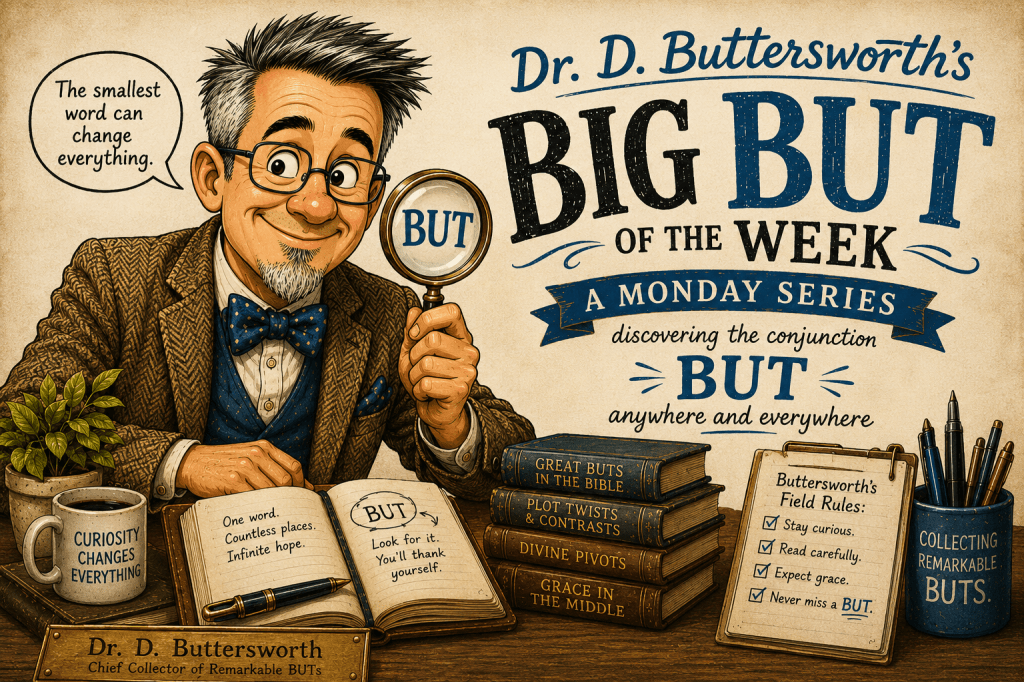
I have recently learned that Hollywood is preparing another cinematic excursion into the land of Narnia. Naturally, I immediately began investigating the literary credentials of its creator, one C. S. Lewis. Imagine my delight upon discovering that Mr. Lewis understood the theological importance of the conjunction BUT. Indeed, he once entrusted the entire reputation of a lion to it.
For those unfamiliar with Narnia, Mr. Lewis was an Oxford and Cambridge scholar, a Christian thinker, and the author of a series of children’s books featuring talking animals, enchanted wardrobes, and a remarkable lion named Aslan. I am generally suspicious of talking animals, particularly those who demonstrate greater theological understanding than certain members of the clergy. Nevertheless, I pressed forward.
My investigation led me to a conversation in The Lion, the Witch and the Wardrobe. The children have heard about Aslan, the great lion, and are understandably concerned about meeting him. After all, lions are large, powerful creatures with exceptionally sharp teeth. One does not ordinarily approach such animals without considerable caution and, preferably, a sturdy fence.
When Susan asks whether Aslan is safe, Mr. Beaver offers this rather startling reassurance:
“’Course he isn’t safe. But he’s good.”
There it is! A magnificent BUT, positioned precisely where it belongs, between two ideas that appear contradictory but are not.
I confess that I was delighted. Mr. Lewis had accomplished in six words what certain theologians require six hundred pages to explain. Naturally, I would never suggest that those six hundred pages are unnecessary. Academic publishing has its standards.
An Important Distinction
Let us examine the conjunction.
The word but introduces a contrast. We expect one thing, but discover another. We anticipate a particular conclusion, but something interrupts our assumptions.
In this instance, the children want to know whether Aslan is safe. Mr. Beaver answers a different, more important question. Aslan may not be safe, but he is good.
Notice what Mr. Beaver does not say. He does not promise that Aslan will behave predictably, avoid unpleasant circumstances, or accommodate everyone’s preferences. He simply affirms the lion’s goodness.
And this, dear readers, brings us to a rather uncomfortable theological observation.
We humans have a remarkable tendency to confuse God’s goodness with our personal comfort.
We pray for protection, provision, peace, and favorable outcomes. These are perfectly reasonable requests. Scripture encourages us to bring our concerns to God. Yet somewhere along the way, we may begin to assume that if God is good, nothing particularly unpleasant should happen to us.
A good God, we reason, would surely prevent disappointment, suffering, uncertainty, and those occasions when the automobile makes an expensive noise.
Unfortunately, neither Scripture nor experience supports this arrangement.
The God Who Doesn’t Fit Our Expectations
Consider the disciples crossing the Sea of Galilee. Jesus was with them, yet a violent storm threatened to overwhelm their boat. They were frightened, and understandably so. Their circumstances were genuinely dangerous.
Jesus did not apologize for allowing the storm to occur. Instead, he calmed it, leaving the disciples with an even more unsettling question:
“Who is this? Even the wind and the waves obey him!” –Mark 4:41
They had been afraid of the storm. Now they were astonished by the One who commanded it.
Apparently, discovering the power of God does not always make us feel immediately comfortable.
Or consider Joseph, betrayed by his brothers, sold into slavery, falsely accused, and imprisoned. His circumstances were anything but safe. Yet years later, he could tell those same brothers, but God intended it for good” –Genesis 50:20.
There is another extraordinary BUT.
Joseph did not pretend that the harm had been harmless. Betrayal remained betrayal. Injustice remained injustice. But the cruelty of others had not prevented God from working toward something good.
A Word for Those Who Are Afraid
I realize that some readers may find this discussion less academic than I do. Perhaps you are facing circumstances that feel anything but safe. Your health is uncertain. Someone you love is struggling. A relationship has fractured. The future looks frightening, and your prayers have not produced the answers you hoped for.
I would not insult you by suggesting that your fears are imaginary or that faith requires you to dismiss them. Even the disciples were frightened in a boat with Jesus.
Nor should anyone use God’s goodness as an excuse to remain in danger when protection and help are available. Trusting God does not require ignoring genuine threats.
But perhaps Lewis’s lion offers us something worth considering.
God’s goodness is not measured solely by whether our circumstances feel safe.
This does not explain every sorrow. It doesn’t answer every question. And it certainly doesn’t mean that suffering is somehow pleasant or desirable.
It means that when life becomes frightening, we may still have reason to trust the character of the One who loves us.
I began this investigation intending to evaluate Mr. Lewis’s proficiency with conjunctions. I conclude it with considerable respect for his literary judgment.
A lion who is merely safe would make a rather disappointing king of Narnia. A God whose goodness depended entirely upon our comfort would be an equally disappointing foundation for faith.
Lewis understood something important. Goodness is not the same as harmlessness. And the absence of danger is not the measure of love.
So, should you find yourself approaching an uncertain tomorrow, perhaps you can carry a small reminder from a talking beaver and a very large lion.
He isn’t safe. But he’s good.
Dr. D. Buttersworth continues his scholarly investigations into the Bible’s most consequential conjunction. His findings are published here every Monday.


Please comment!