
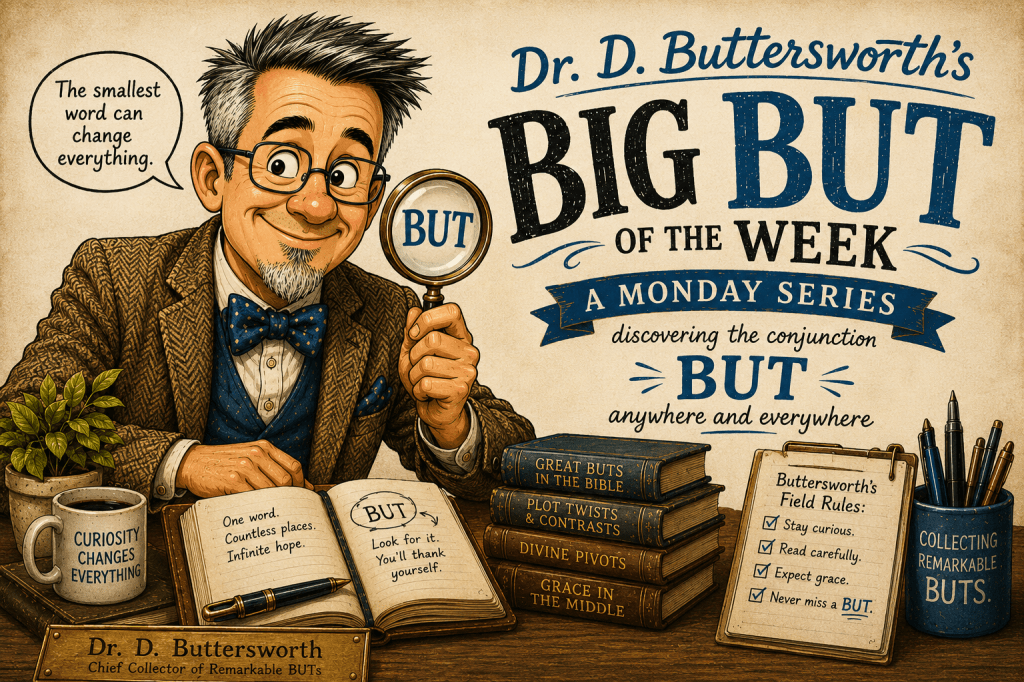
Christian Orthodoxy: Brought to You in Part by the Word BUT
Students, I have made a discovery. An important discovery. Potentially the sort of discovery upon which distinguished academic careers are built, reputations established, endowed chairs offered and small bronze plaques eventually affixed to library walls.
For some time, your good doctor has attempted to impress upon you the extraordinary importance of the humble conjunction but. Some of you have listened attentively. Others have smiled politely, quietly suspecting that I have perhaps devoted far more intellectual energy to a three-letter word than is warranted.
I now have evidence to the contrary. Christian orthodoxy itself has, on occasion, depended upon a properly positioned BUT.
Our evidence comes from the Athanasian Creed, one of Christianity’s ancient statements of faith. There is an immediate complication however: despite its name, Athanasius almost certainly didn’t write it. He was the great fourth-century bishop of Alexandria and defender of Christ’s deity, but the creed bearing his name appeared later, was originally written in Latin, and its actual author remains unknown.
Students, we have encountered our first historical problem, and we haven’t even reached the conjunctions.
Whoever wrote it was attempting something enormously difficult: putting human language around the Christian understanding of the Trinity and the person of Jesus Christ. How can God be one, yet Father, Son and Holy Spirit? How can Jesus be truly God and truly human? These are not small questions. Fortunately for Christianity, our unidentified theologian appears to have had an excellent grasp of conjunctions.
Consider:
“The Father eternal, the Son eternal: and the Holy Ghost eternal. And yet they are not three eternals: but one eternal.”
And then:
“So the Father is God, the Son is God: and the Holy Ghost is God. And yet they are not three Gods: but one God.”
There it is.
The Father is God. The Son is God. The Holy Spirit is God. Naturally, you begin doing the arithmetic. One plus one plus one, carry the—
BUT.
Put down your pencil. Not three Gods: but one God.
This is where things become particularly interesting to a scholar of my specialized expertise. Usually but signals a change in direction. Here it works more like a theological emergency brake. The creed tells us something true about God and then immediately prevents us from taking that truth somewhere it was never intended to go. The second statement doesn’t erase the first; it keeps us from misunderstanding it.
Students, this is sophisticated conjunction work.
And then we get to Jesus.
The creed says that Christ is both God and man, “yet he is not two, but one Christ.” It continues: “One altogether, not by confusion of Substance: but by unity of Person.”
At this point, the evidence becomes overwhelming. Centuries before the establishment of the Buttersworth Institute for Advanced Conjunction Studies—which, admittedly, remains pending accreditation—Christians were using but to protect some of the most important things they believed about Jesus.
There’s something deeper here than grammatical amusement. The Christians who formulated and preserved these ancient statements weren’t trying to explain away the mystery of God. They were trying to protect it. Scripture had led them to truths that had to be held together: God is one, yet Father, Son and Holy Spirit are each divine. Jesus is God, yet He became truly human.
Rather than discard one truth because another made it difficult, the creed repeatedly says, in effect: Yes. But don’t forget this.
That’s an interesting role for our favorite conjunction. Sometimes but changes the story. Sometimes it introduces an exception. And sometimes but keeps us from holding one truth so tightly that we lose another truth standing right beside it.
Eventually, all this theology leads back to the story at the center of Christianity. The creed moves from describing who Jesus is to remembering what Jesus did: He suffered for our salvation, rose from the dead, ascended, and will come again.
These early Christians cared deeply about getting their language about Jesus right because they believed Jesus mattered that much. The Gospel matters this much.
And so we add the Athanasian Creed to our growing collection of important buts. Long before Big Buts of the Bible, long before this website, and certainly long before your professor began his tireless campaign for proper conjunction appreciation, Christians were already reaching for our favorite little word when trying to speak carefully about their God.
They would make one extraordinary statement, then another. And just when human language seemed in danger of running off the theological road—BUT.
A guardrail. A boundary. A reminder that the truth on one side must be held together with the truth on the other.
Your assignment this week is to find the Athanasian Creed and read it for yourself. Circle every but you find.
Extra credit for yet.Class dismissed.

