
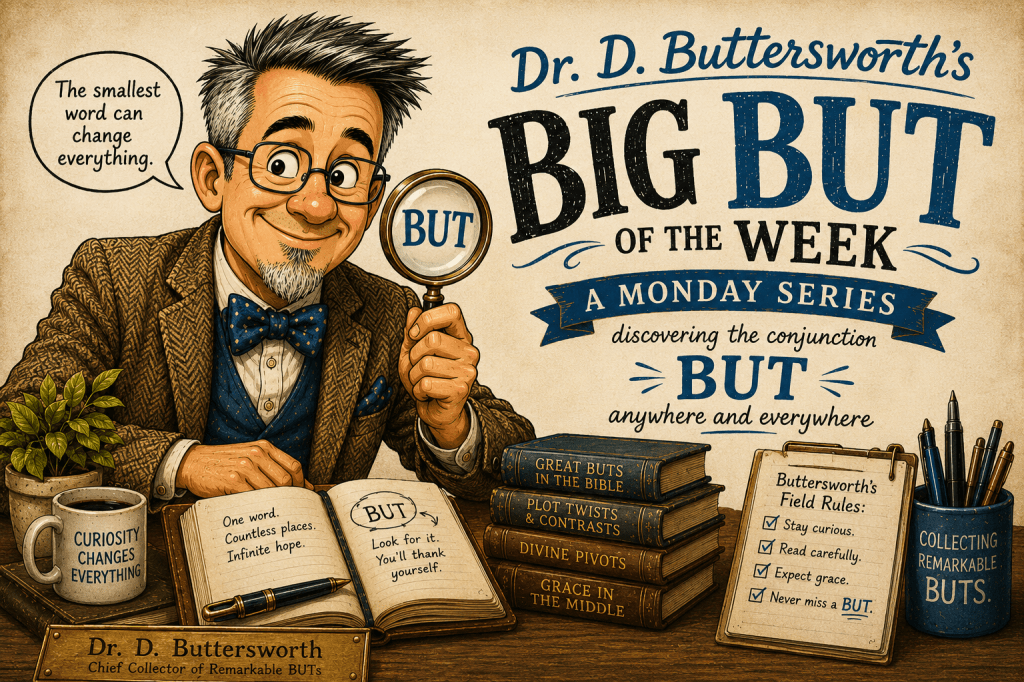
As longtime students know, the doctor occasionally ventures beyond Scripture in search of his favorite conjunction. He has discovered buts hiding in literature, speeches, popular culture, and—because the doctor appreciates a good tune—music.
Today he has wandered into an old hymnal.
And there, waiting patiently for nearly three centuries, he found a beauty.
Meet Mr. Watts
Isaac Watts was born in England in 1674 and became a Congregational minister, theologian, educator, and one of the most influential hymn writers in Christian history. He is often called the “Father of English Hymnody.” Before Watts, English Protestant congregational singing was dominated by metrical versions of the Psalms. Watts helped change that, writing songs that allowed Christians to sing biblical truth explicitly through the lens of Christ and the gospel.
That might not sound particularly revolutionary today. We live in a world of worship bands, hymnals, praise choruses, Spotify playlists, guitars, organs, drums, choirs, and—depending upon your particular church tradition—perhaps even the occasional fog machine.
But in Watts’ world, writing new songs for Christians to sing was something of an innovation.
And Watts was prolific. His work gave the church enduring hymns such as When I Survey the Wondrous Cross, O God, Our Help in Ages Past, and the Psalm 98 paraphrase we know as Joy to the World. His hymns helped reshape English-speaking Christian worship for generations.
Dr. Buttersworth approves.
But that’s not why we’re here.
We’re here because Isaac Watts knew how to use a conjunction.
Among Watts’ hymns is one of my favorites, I Sing the Mighty Power of God. It was originally written for children and appeared in his 1715 collection Divine and Moral Songs for Children. Watts wanted children to understand great truths about God in language they could grasp and remember.
And what truths he gave them.
The hymn looks around at creation and sees evidence of the Creator everywhere—the earth, the seas, the skies, the sun, the moon, the stars. The world surrounding us becomes a testimony to the power, wisdom, goodness, providence, and presence of God.
Then, in the final verse, Dr. Buttersworth spots his word:
There’s not a plant or flower below, but makes Thy glories known.
But.
There’s our little conjunction.
And what a magnificent but it is.
Not a Flower. Not a Cloud. Not You.
Read Watts’ line carefully. He isn’t contrasting two opposing ideas in quite the way our biblical buts often do. Here the older construction essentially means that there isn’t a plant or flower anywhere that doesn’t make God’s glory known.
Look around.
That flower? God’s glory.
The tree outside your window? God’s glory.
Clouds gathering before a storm? God’s glory.
The sunrise you barely noticed because you were running late for work? God’s glory.
Watts continues by describing clouds and tempests, then widens the lens to encompass everything possessing life. His conclusion is wonderfully simple: wherever we go, God is there and His creation bears witness to Him.
It sounds remarkably like the psalmist: “The heavens declare the glory of God; the skies proclaim the work of his hands.”
Creation is preaching.
The question is whether we’re listening.
Maybe that’s why I love this particular but so much.
We tend to go looking for God in extraordinary places. We want the miracle, the unmistakable answer, the mountaintop experience, the booming voice from heaven. Meanwhile, Watts invites us to look down at the little flower growing beside our feet.
God’s glory was there all along.
For those with eyes to see, the ordinary world becomes extraordinary. Creation is filled with fingerprints. Life itself bears witness to its Giver.
Nearly three hundred years ago, Isaac Watts wrote a children’s hymn inviting us to notice.
And Dr. Buttersworth has discovered that sometimes one little but is enough to make us stop and look again.
There’s not a plant or flower below, but makes Thy glories known.Class dismissed.

