
But God!
Dr. Buttersworth has a confession to make. He cannot walk past a used bookstore. Particularly one with an old theology section. You know the kind… Dusty shelves. Yellowed pages. Books no one has checked out in many years. The kind of place where retired pastors’ and professors’ libraries eventually find new homes.
While most people are looking for first editions of Hemingway or Tolkien… Dr. Buttersworth is over in aisle seven grinning because, deep in a cardboard box, he just unearthed a 1962 copy of But God by F. Raymond Edmond.
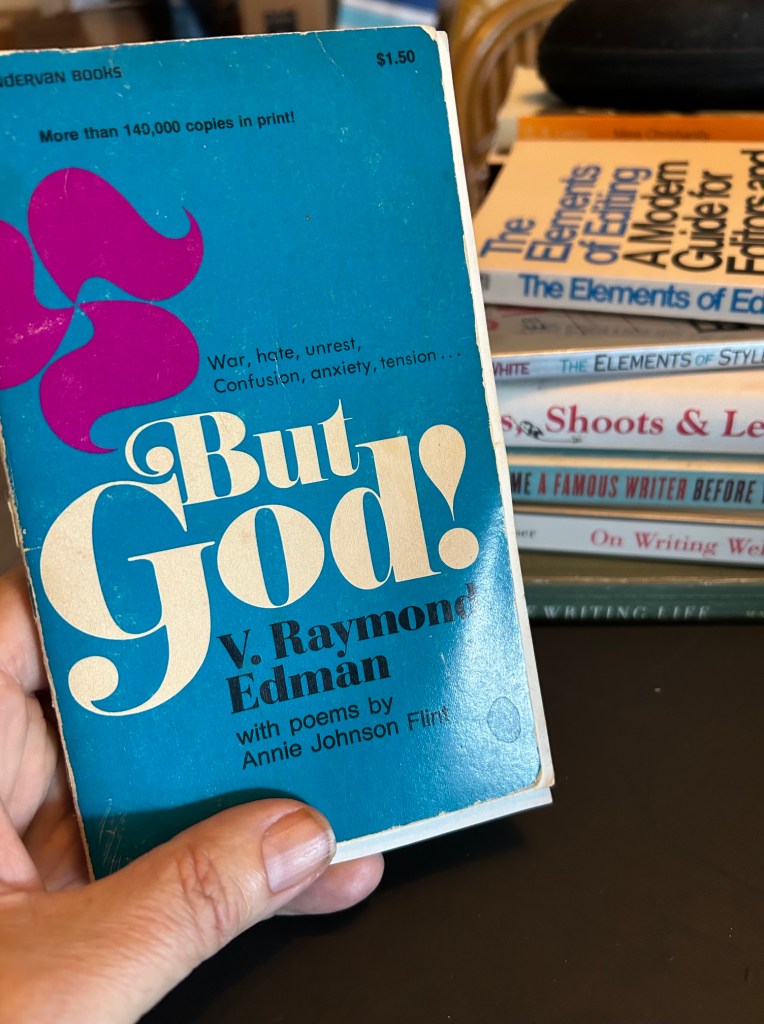
For 50 cents! (Two-for-a-dollar, you can also get a pristine copy of How to Keep Your Church Furnace Running Through the Winter of 1938. O, the bargains!)
Once I got past admiring the price and the wonderfully outdated cover design, I realized Edmond had stumbled onto something remarkable. Throughout Scripture, there are moments when human ability reaches its absolute limit… But God…
What a beautiful phrase. It appears 72 times in the NIV, and every single time it marks a divine interruption.
Human plans… But God.
Human failure… But God.
Human weakness… But God.
Human impossibility… But God.
It’s almost as if that little conjunction announces, “Stand back… God is about to do what only God can do.”
Let me share a couple examples.
Genesis 50:20 – Joseph tells his brothers, “You intended to harm me, but God intended it for good…”
Human evil. Divine redemption.
Romans 5:8 – Paul states, “But God demonstrates his own love for us in this: While we were still sinners, Christ died for us.”
Dead in sin… But God.
You could write an entire theology of grace from those two words.
Dr. Buttersworth has a a little homework assignment for you this week. The next time you read your Bible, search for “But God.” You’ll begin to notice a pattern. Whenever human strength runs out… God’s never does.
Whenever our plans fall apart… God’s purpose keeps moving.
Whenever the story appears finished… God picks up the pen.
Perhaps that’s why this tiny phrase has become one of the Bible’s most hope-filled expressions. Because it reminds us that the last word rarely belongs to us. It belongs to God.
Now, if you’ll excuse Dr. Buttersworth, He really did come into the bookstore looking for another title … The Proper Use of Mimeograph Machines in Evangelistic Outreach.
Don’t laugh. It’s a classic.

