
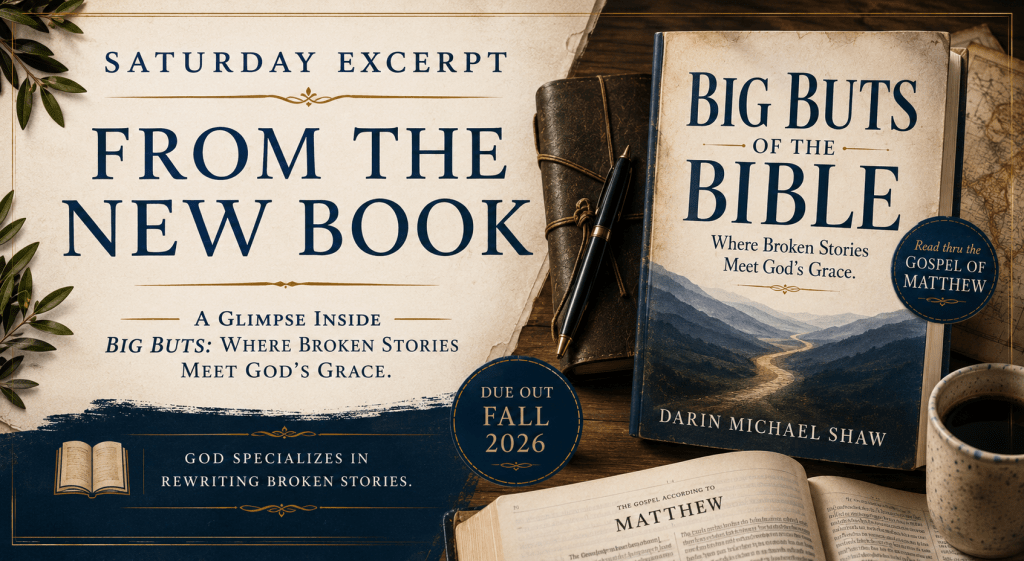
An Excerpt from Chapter 5 ~ The Sermon on the Mount
The big but of Matthew 5 appears repeatedly as an instrument in Jesus’ teaching:“You have heard it said … but I tell you …”
The beginning of the Sermon on the Mount sets the stage for all the other teachings of Jesus. He’s going to proclaim many a paradox along the way—the last will be first; the least will be greatest; to possess nothing is to have all; to bear a cross is to wear a crown, and so on. He’s not exactly promising a rose garden for those who would follow after Him. But in these beatitudes, He reveals something more—His heart.
One of my favorite moments in the television series The Chosen is a scene where Jesus explains to Matthew that the Beatitudes are, in a sense, a roadmap to where people can find Him. The poor in spirit. Those who mourn. The meek. The persecuted. Of course, there’s no biblical record of that conversation ever taking place. It’s an imaginative, extra-biblical moment created by the writers of the show. But even so, it resonates deeply with me because it feels profoundly consistent with the Jesus we actually encounter throughout the Gospels.
When you step back and look at His ministry, Jesus continually positioned Himself among the broken, weary, grieving, rejected, and spiritually exhausted. He was found among lepers, widows, outcasts, sinners, the poor, the ashamed, and those crushed beneath the weight of life. The Beatitudes suddenly begin to feel less like a list of lofty spiritual ideals and more like a description of the very people gathered around Him. In that sense, the scene in The Chosen doesn’t feel like a distortion of Jesus’ heart at all. It feels like a thoughtful meditation on it.
I think there’s something deeply worth considering there as believers study the Beatitudes. Perhaps Jesus wasn’t merely describing the kind of people who inherit the kingdom someday, but also revealing the kinds of places where His presence is most often discovered here and now. History—and many wounded souls—have sometimes turned Christianity into a religion of strength, polish, certainty, and performance. Some have even sought to turn it into political clout or social mandates. But the Beatitudes point us in another direction entirely. They remind us that Christ has always drawn near to the humble, the hurting, the merciful, and the desperate enough to know they need Him.
This is the kingdom economy.
 Big Buts of the Bible
Please comment!