
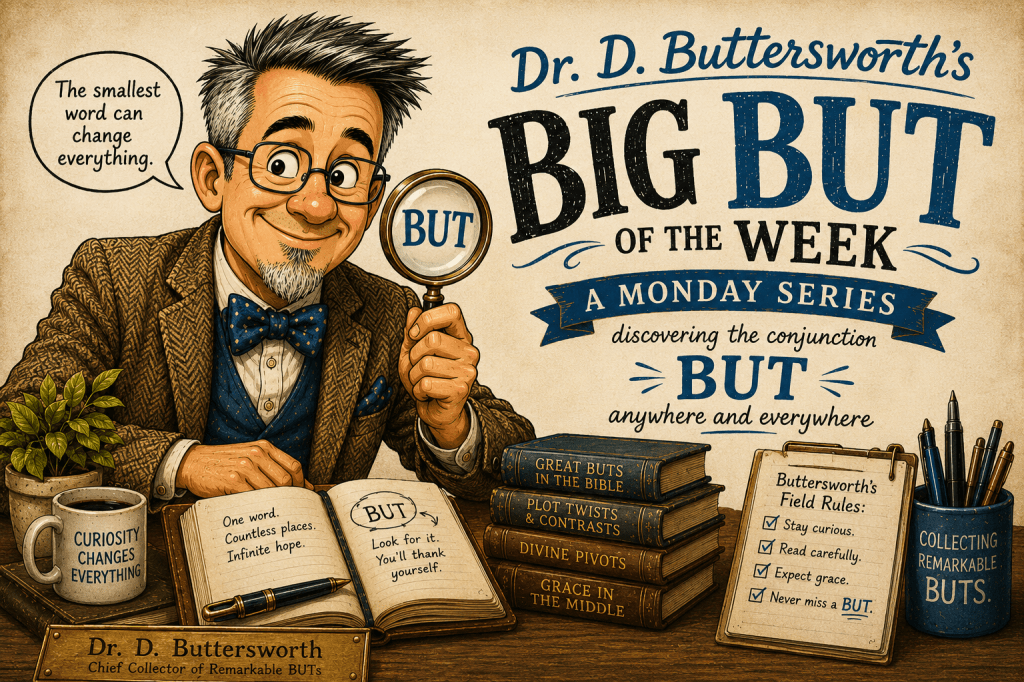
Big Buts of the Bible continues publishing after Mondays.
Apparently Big Buts of the Bible is still here on Tuesdays. And through the rest of the week.
I had no idea.
For some time, I have assumed my Monday scholarly contributions represented the principal intellectual work occurring here. This seemed reasonable. Monday is, after all, when your good doctor provides linguistic insight, biblical scholarship, historical investigation and the occasional completely unnecessary exploration of our favorite three-letter conjunction.
Apparently, while I have been researching conjunctions, everyone else has been using them. Naturally, I felt obligated to investigate.
On Tuesday…
My first discovery was something called Hope Hidden in Plain Sight.
Tuesday’s posts, apparently, searches Scripture for places where hope has been sitting there all along, tucked behind a but, waiting for somebody to notice.
This sounds suspiciously similar to my own work, except with less discussion of Greek particles and … considerably more practical usefulness.
I find this mildly threatening.
Still, I approved of the premise. Scripture is filled with moments when circumstances appear to be saying one thing, butGod, grace, hope or some unexpected possibility says something more.
Tuesday’s researchers apparently believe these things might actually help people.
Interesting approach. I continued.
On Wednesday, someone has been conducting actual research
They call it The Pivot.
For months, Wednesdays have been systematically collecting moments when Scripture turns on a but—places where the story appears to be moving inevitably in one direction until something changes. They call these moments Pivots.
Your good doctor calls them his favorite conjunction in its natural habitat.
The first expedition has been through the five books of Moses: fifteen Pivots from Genesis through Deuteronomy. And there are some beauties.
Abraham raises the knife over Isaac, but the angel of the LORD calls out from heaven.
Pharaoh tries to suppress the Israelites, but the more they are oppressed, the more they multiply.
Moses insists he isn’t eloquent enough for the assignment God has given him, but God isn’t particularly impressed with his excuse.
The spies return from Canaan talking about powerful people, fortified cities and giants. But Caleb… Caleb sees everything they see and reaches a completely different conclusion: “We should go up and take possession of the land, for we can certainly do it.”
This is excellent conjunction work. I wish I had thought of it.
And I just learned the researchers are now preparing to move into the twelve Historical Books—Joshua through Esther—for another fifteen. This is a rich shaft to mine!
I’ve reviewed some preliminary findings. There is a wealth of ‘pivotal’ material to dig into here.
Gideon looks at himself and asks, “But how can I save Israel?”
Ruth is given every reasonable opportunity to walk away, but Ruth replies, “Where you go I will go…”
Samuel looks at Eliab and sees a king. But the LORD looks at the heart.
Elijah believes he is the only faithful one left. Yet God has reserved seven thousand.
Yes, yet. Apparently some Big Buts travel under assumed names. We have recently covered this in class. Please try to keep up.
Then there’s Ezra, looking honestly at generations of failure and its painful consequences: “But now… the LORD our God has been gracious…”
And Nehemiah, surrounded by people trying to stop the rebuilding: “But we prayed to our God…”
At this point in my investigation, I realized something. These aren’t merely interesting uses of a conjunction. They’re stories of people standing at turning points.
Fear says one thing.
Failure says one thing.
Circumstances say one thing.
Other people say one thing.
Sometimes our own hearts say one thing.
But…
Don’t stop reading. There may be more to the story.
Thursday. Friday. Saturday—there’s something happening here every day of the week!
Further investigation is warranted.
Then I Found Sunday.
Sunday does something rather unexpected. It stops looking quite so closely at the conjunction and looks instead at the God who so often stands on the other side of it.
I discovered Sunday Worship, Wonder & Awe. This caused me to reconsider my research.
I have spent considerable time studying but—where it came from, how it works, what Greek and Hebrew words may lurk behind it, and why biblical writers and English translators use these little turns of language.
But perhaps the conjunction was never the star.
Maybe it simply points. It tells us: Don’t stop here.
Don’t assume what you’ve seen so far is everything there is to see. Don’t assume the present chapter is the final chapter. Keep reading. Because remarkably often, somewhere on the other side of the turn, we discover God.
That may be the real secret behind all these Big Buts.
I began this investigation somewhat concerned that the rest of the staff might be mishandling my favorite conjunction. I have discovered something else: They understand it.
I haven’t yet inspected everything happening around here. Your homework assignment is to investigate independently and report back. What did you see? What can you take away? What can you pass on to others? And who needs to hear these things?

