
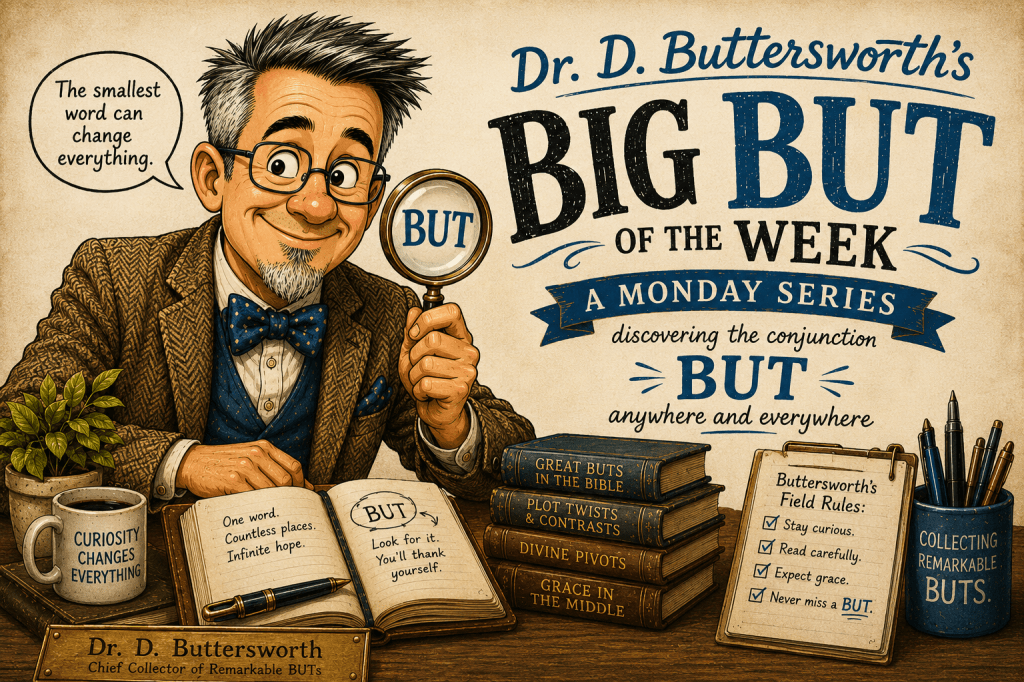
Dr. Buttersworth has been reading the Heidelberg Catechism again.
Longtime students will recall that we’ve visited this document before and discovered something rather remarkable: apparently the theologians responsible for the Heidelberg Catechism understood the extraordinary theological usefulness of a well-placed conjunction.
The Doctor approves. And today he’s found another one.
This time it doesn’t appear buried somewhere in the answer. It begins the question.
From Heidelberg Catechism Q&A 8:
Q. BUT are we so corrupt that we are totally unable to do any good and inclined toward all evil?
A. Yes, unless we are born again by the Spirit of God.
But.
Class, you know what to do.
Whenever a sentence begins with but, something came before it. Our little conjunction is turning our attention backward before moving us forward. So let’s back up.
How Did We Get Here?
Question 6 asks whether God created human beings wicked and perverse.
The Catechism’s answer is no. God created humanity good and in His own image, that we might know Him, love Him, and live with Him.
So what happened?
Question 7 takes us back to the fall of Adam and Eve and explains that sin corrupted human nature. Something has gone terribly wrong with God’s good creation.
Which brings us to Question 8:
BUT are we so corrupt…?
You can almost hear the objection.
Okay, things went badly in Eden. Granted. But surely we’re not completely helpless. Can’t we straighten ourselves out?Can’t we resolve to do better? Can’t we become better people if we try hard enough?
Surely mankind has fallen… but can’t we get up?
The Catechism’s answer is rather blunt: No.
Or, more precisely: “Yes, unless we are born again by the Spirit of God.”
And suddenly that little but has led us to an even more important word: Unless.
Dr. Buttersworth may need to broaden his research.
The Bad News Before the Good News
This isn’t exactly the most uplifting diagnosis of the human condition. We tend to prefer messages about discovering the strength within ourselves. Try harder. Dig deeper. Become the best version of yourself.
The Heidelberg Catechism says our problem runs deeper than that. We don’t merely need improvement. We need new life.
Jesus said essentially the same thing to Nicodemus in John 3: You must be born again.
And that’s why Question 8 is important. The Catechism is preparing to turn a corner. Its opening questions have been describing our misery—what has gone wrong with us and why we cannot repair it ourselves.
Soon it will begin pointing us toward deliverance. Toward mercy. Toward grace.
Toward Jesus.
But before we can appreciate God’s remedy, we have to understand the diagnosis. We cannot rescue ourselves.
God must do for us what we cannot do for ourselves.
And class, if you’ve spent any time around here, you know what we’re looking for whenever the story appears hopeless. A really big but.
Your Assignment
Dr. Buttersworth is assigning homework. Sometime over the next few weeks, pick up—or Google up—a copy of the Heidelberg Catechism and read through it with your grammatical eyes open.
Don’t worry. There are only 129 questions and answers.
The Doctor expects a full report by morning.
Kidding.
Instead, see whether you can spot some of its buts. There are several grammatical gems tucked throughout this nearly 500-year-old document, and from time to time we’ll bring one back to class and see what theological work that little conjunction is doing.
Consider it a catechismal treasure hunt.
Today’s discovery? Humanity has ‘fallen and cannot get up.’ That sounds like very bad news. Or … a Life Alert television commercial?
But seriously, we’re headed toward the Good News.
Keep following the buts.Class dismissed.

